White House says Libyan conflict too limited to violate War Powers law
A bipartisan group of House lawmakers went to court Wednesday to try to stop President Obama’s troop deployment to Libya, but the White House submitted a report to Congress arguing it is adhering to the War Powers Resolution because it is not actually engaged in “hostilities.”
“U.S. operations do not involve sustained fighting or active exchanges of fire with hostile forces, nor do they involve the presence of U.S. ground troops, U.S. casualties or a serious threat thereof,” the administration said in a 32-page public report, which was sent to Congress along with a classified annex describing in more detail the rebels the U.S. is aiding.
Still, senior administration officials briefing reporters acknowledged that U.S. Unmanned Aerial Vehicles are making strikes in Libya, and said U.S. warplanes are still flying sorties and can respond if fired upon. Those actions would seem to test the limits of what is considered hostile action under the 1973 War Powers Resolution.
The report also gives a detailed look at spending on the conflict. Military spending totaled $715.9 million through June 3, of which more than half of that total is expended munitions. By Sept. 30, the end of the fiscal year, that will have grown to $1.1 billion, with another $50 million spent on munitions over the final four months.
Obama administration officials said those funds are being shifted from within the Defense Department and it doesn’t see a need to request emergency funds from Congress. Such a request would likely precipitate a major fight on Capitol Hill over whether the president should be allowed to continue the mission.
The State Department has spent an additional $3.7 million, and the government has committed nearly $81 million more toward humanitarian assistance.
Administration officials said they are not contesting the constitutionality of the War Powers Resolution, which places limits on the president’s ability to commit U.S. troops to fighting.
But Congress may see it differently.
On Tuesday House Speaker John A. Boehner, Ohio Republican, wrote a letter to Mr. Obama saying if he doesn’t withdraw troops or get Congress’s approval by Sunday, he could run afoul of the War Powers Resolution. And earlier this month the House passed a resolution setting a Friday deadline for the administration to provide detailed information on the extent and goals of its Libyan operations.
Mr. Obama approved U.S. strikes on Libya in March while on a trip to Latin America, saying Libyan regime leader Col. Moammar Gadhafi had threatened to show “no mercy” to those supporting the rebellion in the country’s east.
The strikes began March 19, and two days later the president sent notification to Congress of the action, complying with that part of the War Powers Resolution. Since then, the administration says it has conducted at least 30 briefings for congressional members and staff, which the White House said fulfills a duty to consult with Congress.
But lawmakers said the War Powers Resolution requires more than consultation, it requires an affirmative vote if the president wants to commit to military action for an extended period of time.
“The Constitution requires the president to ‘take care that the laws be faithfully executed,’ and one of those laws is the War Powers Resolution, which requires an approving action by Congress or withdrawal within 90 days from the notification of a military operation,” Mr. Boehner said in his letter to the president.
Sunday would be the 90th day since the U.S. first took action in Libya.
The House earlier this month passed a resolution that contained a veiled threat to cut off funding for the operation unless Mr. Obama provided extensive information.
U.S. voters hold conflicted views on U.S. involvement. A Fox News Poll taken last week found Americans oppose the mission by a nearly 2-to-1 ratio, and substantial majorities said Mr. Obama had not articulated a cogent reason for U.S. involvement.
Still, other polls show a majority of voters are comfortable with what the U.S. military is doing in Libya now, yet also want to see the coalition specifically target Col. Gadhafi.
Meanwhile, some members of Congress went to court Wednesday to try to force an end to U.S. action.
Rep. Dennis J. Kucinich, an Ohio Democrat who has carved out extensive anti-war credentials, led a group of two other Democrats and seven Republicans in the House in suing in federal court.
They are asking for an injunction to halt U.S. involvement in NATO’s operations, and want the court to weigh in on the broader issue of whether the president needs proactive congressional authorization to commit military forces.
“We believe that the law was violated. We have asked the courts to move to protect the American people from the results of these illegal policies,” said Rep. Dennis J. Kucinich, an Ohio Democrat who is leading the lawsuit.
The complaint names both Mr. Obama and Defense Secretary Robert M. Gates
The Washington Times, LLC
Click Here for Original Story

Wednesday, June 15, 2011

Saturday, June 11, 2011
Residents Moving out of Nanny States....
New Jersey and New York Ranked as Worst States for "Individual Freedoms"

Click here for the entire story.... What an odd concept
Live free or die? New Hampshire may be on to something, according to researchers at George Mason University's Mercatus Center.
They used a variety of statistics to rank the 50 states for their just-published report on which states are the freest -- and least free -- from taxes and government regulation.
Their horserace has ranked New York as the "least free state in the Union" followed by neighboring New Jersey. New Hampshire and South Dakota were in a virtual tie for most "free" state.
The professors who authored the study believe that this freedom as they define it makes a lot of difference to the happiness and well-being of the governed.
Many people "don't want to have their lives dictated by people in their state capital," says William Ruger, political science professor at Texas State University-San Marcos, who co-authored the report with Jason Sorens, political science professor at the University at Buffalo, State University of New York.
"As academics, we were first interested in the scientific question of how states differ, why, and with what implications," said Ruger. "It was natural to then compare them in terms of their respect for individual freedom given how important this is to both of us."
Ruger, who is in the reserve component of the Navy, served in Afghanistan from 2008 to 2009. He said his project was not related to his time in Afghanistan, though "those who love freedom ought to take it upon themselves to defend and uphold our individual rights."
"Sometimes we do so with the pen, sometimes with the sword," he said.
New York was ranked dead last in part because it has the highest taxes in the country, including those on property, selective sales, individual income and corporate-income, according to the report. They cited New York's spending on "other and unallocable" expenses, including public welfare, hospitals, electric power, transit, and employee retirement, as another reason for its ranking.
The report created four other lists ranking freedom based on fiscal policy, regulatory policy, economic freedom and personal freedom. They did not attempt to weigh the benefits bestowed on the populace by their government and its policies.
Maryland was ranked last based on personal freedom, though it was #43 in overall freedom. The report cited Maryland's gun laws, which are the second-strictest in the country, as well as "fairly harsh" marijuana laws, extensive auto regulations, harsh gambling laws, "burdensome" homeschooling laws, high drug arrest rates and lack of status for same-sex partnerships.
The report makes policy recommendations for each state, such as proposing that Maryland legalize same-sex civil unions and strengthen medical-marijuana laws while decriminalizing low-level possession.
It is unclear how Georgia's ranking -- #15 in overall freedom, #11 in economic freedom and #31 in personal freedom -- may bode for the Obama administration's health care law. A federal appeals court in the Peach State will hear a challenge on Wednesday brought by 26 states to the constitutionality of the Affordable Care Act signed into law in March 2010.
George Mason University's report is not without its critics, however.
Carl Davis, senior policy analyst for the nonprofit group Citizens for Tax Justice, is critical of the report's "shallow and misleading" analysis of taxation when scoring a state's freedom score.
"You can't just count the number of dollars coming in," Davis said. "It's just as important to look at how those dollars are collected, and from whom, and the study makes basically no attempt to do either of these things."
But Ruger said there are two critical policy implications from the study that could have serious economic implications.
First, freer states are attracting citizens from other states while less-free states are losing citizens -- and their tax dollars.
"This is true for both economic freedom and personal freedom," Ruger said. "People are voting with their feet and moving to open, tolerant, and economically free states and away from nanny-states."
As an example, increasing points on the "freedom scale" by 0.5 points, from Connecticut to Iowa, for example, increases net migration by 5.9 percentage points, based on population figures from 2000, according to the report.
Second, Ruger said that economic freedom is associated with income growth. The study results showed that a 0.25 unit increase in economic freedom increases the average annual growth rate in personal income by about 0.25 percentage points.
Statistically speaking, South Dakota should have a growing population and increasing incomes because the state ranked first in economic freedom and second in overall freedom. Census Bureau data shows more people at least moved to South Dakota from other states (29,631) than left for another state (25,950) in 2009.
Copied from ABC News, used without permission
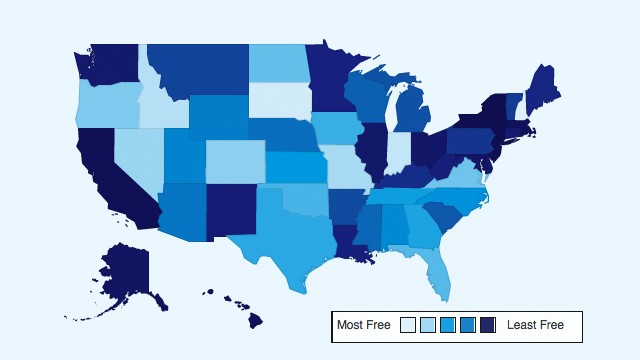
Click here for the entire story.... What an odd concept
Live free or die? New Hampshire may be on to something, according to researchers at George Mason University's Mercatus Center.
They used a variety of statistics to rank the 50 states for their just-published report on which states are the freest -- and least free -- from taxes and government regulation.
Their horserace has ranked New York as the "least free state in the Union" followed by neighboring New Jersey. New Hampshire and South Dakota were in a virtual tie for most "free" state.
The professors who authored the study believe that this freedom as they define it makes a lot of difference to the happiness and well-being of the governed.
Many people "don't want to have their lives dictated by people in their state capital," says William Ruger, political science professor at Texas State University-San Marcos, who co-authored the report with Jason Sorens, political science professor at the University at Buffalo, State University of New York.
"As academics, we were first interested in the scientific question of how states differ, why, and with what implications," said Ruger. "It was natural to then compare them in terms of their respect for individual freedom given how important this is to both of us."
Ruger, who is in the reserve component of the Navy, served in Afghanistan from 2008 to 2009. He said his project was not related to his time in Afghanistan, though "those who love freedom ought to take it upon themselves to defend and uphold our individual rights."
"Sometimes we do so with the pen, sometimes with the sword," he said.
New York was ranked dead last in part because it has the highest taxes in the country, including those on property, selective sales, individual income and corporate-income, according to the report. They cited New York's spending on "other and unallocable" expenses, including public welfare, hospitals, electric power, transit, and employee retirement, as another reason for its ranking.
The report created four other lists ranking freedom based on fiscal policy, regulatory policy, economic freedom and personal freedom. They did not attempt to weigh the benefits bestowed on the populace by their government and its policies.
Maryland was ranked last based on personal freedom, though it was #43 in overall freedom. The report cited Maryland's gun laws, which are the second-strictest in the country, as well as "fairly harsh" marijuana laws, extensive auto regulations, harsh gambling laws, "burdensome" homeschooling laws, high drug arrest rates and lack of status for same-sex partnerships.
The report makes policy recommendations for each state, such as proposing that Maryland legalize same-sex civil unions and strengthen medical-marijuana laws while decriminalizing low-level possession.
It is unclear how Georgia's ranking -- #15 in overall freedom, #11 in economic freedom and #31 in personal freedom -- may bode for the Obama administration's health care law. A federal appeals court in the Peach State will hear a challenge on Wednesday brought by 26 states to the constitutionality of the Affordable Care Act signed into law in March 2010.
George Mason University's report is not without its critics, however.
Carl Davis, senior policy analyst for the nonprofit group Citizens for Tax Justice, is critical of the report's "shallow and misleading" analysis of taxation when scoring a state's freedom score.
"You can't just count the number of dollars coming in," Davis said. "It's just as important to look at how those dollars are collected, and from whom, and the study makes basically no attempt to do either of these things."
But Ruger said there are two critical policy implications from the study that could have serious economic implications.
First, freer states are attracting citizens from other states while less-free states are losing citizens -- and their tax dollars.
"This is true for both economic freedom and personal freedom," Ruger said. "People are voting with their feet and moving to open, tolerant, and economically free states and away from nanny-states."
As an example, increasing points on the "freedom scale" by 0.5 points, from Connecticut to Iowa, for example, increases net migration by 5.9 percentage points, based on population figures from 2000, according to the report.
Second, Ruger said that economic freedom is associated with income growth. The study results showed that a 0.25 unit increase in economic freedom increases the average annual growth rate in personal income by about 0.25 percentage points.
Statistically speaking, South Dakota should have a growing population and increasing incomes because the state ranked first in economic freedom and second in overall freedom. Census Bureau data shows more people at least moved to South Dakota from other states (29,631) than left for another state (25,950) in 2009.
Copied from ABC News, used without permission
Wednesday, June 8, 2011
Your government is stealing from you.....And destroying your future.....
Your-household-s-share-of-unfunded-obligations-$527,000
The federal government's financial condition deteriorated rapidly last year, far beyond the $1.5 trillion in new debt taken on to finance the budget deficit, a USA Today analysis shows.
The government added $5.3 trillion in new financial obligations in 2010, largely for retirement programs such as Medicare and Social Security. That brings to a record $61.6 trillion the total of financial promises not paid for.
This gap between spending commitments and revenue last year equals more than one-third of the nation's gross domestic product.
Medicare alone took on $1.8 trillion in new liabilities, more than the record deficit that's prompting heated debate between Congress and the White House over lifting the debt ceiling.
Social Security added $1.4 trillion in obligations, partly reflecting longer life expectancies. Federal and military retirement programs also added to the financial hole.
Corporations would be required to count these new liabilities when they were taken on -- and report a big loss to shareholders. Unlike businesses, however, Congress postpones recording spending commitments until it writes a check.
The $61.6 trillion in unfunded obligations amounts to $527,000 per household. That's more than five times what Americans have borrowed for everything else -- mortgages, car loans and other debt. It reflects the challenge as the number of retirees soars over the next 20 years and seniors try to collect on those spending promises.
"The (federal) debt only tells us what the government owes to the public. It doesn't take into account what's owed to seniors, veterans and retired employees," said accountant Sheila Weinberg, founder of the Institute for Truth in Accounting, a Chicago-based group that advocates better financial reporting. "Without accurate accounting, we can't make good decisions."
USA Today has calculated federal finances based on standard accounting rules since 2004 using data from the Medicare and Social Security annual reports and the little-known audited financial report of the federal government.
Article taken from USA TODAY, used without permission
The government added $5.3 trillion in new financial obligations in 2010, largely for retirement programs such as Medicare and Social Security. That brings to a record $61.6 trillion the total of financial promises not paid for.
This gap between spending commitments and revenue last year equals more than one-third of the nation's gross domestic product.
Medicare alone took on $1.8 trillion in new liabilities, more than the record deficit that's prompting heated debate between Congress and the White House over lifting the debt ceiling.
Social Security added $1.4 trillion in obligations, partly reflecting longer life expectancies. Federal and military retirement programs also added to the financial hole.
Corporations would be required to count these new liabilities when they were taken on -- and report a big loss to shareholders. Unlike businesses, however, Congress postpones recording spending commitments until it writes a check.
The $61.6 trillion in unfunded obligations amounts to $527,000 per household. That's more than five times what Americans have borrowed for everything else -- mortgages, car loans and other debt. It reflects the challenge as the number of retirees soars over the next 20 years and seniors try to collect on those spending promises.
"The (federal) debt only tells us what the government owes to the public. It doesn't take into account what's owed to seniors, veterans and retired employees," said accountant Sheila Weinberg, founder of the Institute for Truth in Accounting, a Chicago-based group that advocates better financial reporting. "Without accurate accounting, we can't make good decisions."
USA Today has calculated federal finances based on standard accounting rules since 2004 using data from the Medicare and Social Security annual reports and the little-known audited financial report of the federal government.
Article taken from USA TODAY, used without permission
Monday, June 6, 2011
There's a Large Supply of Local Male Bovine Droppings too.....
Administrator Raises Irk Taxpayers As Teachers Laid Off
Superintendent Got $30K Raise Months Before Failed Referendum
Click Here to See Entire ArticleAVON, Ind. -- As Avon schools was preparing to ask taxpayers for more money in a May referendum, board members gave Superintendent Timothy Ogle a $30,000 raise, records show.
The board signed off on the 20 percent raise in December, less than five months before voters said no to a referendum, 6News' Kara Kenney reported.Records show Ogle's $155,626 base salary for the 2010-2011 school year ranked in the top 8 percent of superintendents in the state.
Last week, the school district laid off 36 teachers, leaving many taxpayers, parents and students angry."
They have no responsibility, and they put it all on the taxpayers," said parent Libby Farr. "I'm willing and happy to pay more in taxes, but there has to be cuts on the other side."
Ogle declined to meet with 6News until after a June 6 school board meeting, during which he said he plans to offer a $10,000 cut to his own pay.
Ogle pointed out that he personally met with each laid off teacher and explained to 6News that incentive pay rewards administrators for achieving or exceeding their goals for things like student achievement, fiscal responsibility and efficiency, relationships with employees and other measures.
"Soon what the Avon board piloted with their superintendent will be effectively mandated for all Indiana educators, (including) salary changes based on no less than two-third performance and one-third degrees and years of service," Jon Bailey, the district's attorney, said in an email to 6News.
Per Ogle's contract, the school board can elect to pay him an additional basic salary up to $20,000. Bailey said, per statute, the board can pay him above that amount as well.
"I'm not very impressed," said Steve Harlan with No More Avon Taxes, a group that led the fight against the referendum. "How can (Ogle) justify that kind of pay raise knowing full well he doesn't have any operating budget money? It just doesn't make sense to me."
Harlan and Farr said as teachers are losing their jobs, administrators should look at cutting their own pay."
The administrators have to make sacrifices. Why is it always teachers?" Farr said."
We asked them to sharpen their pencil," said Harlan, who said he believes a $10,000 pay cut is not enough. "I think they can do a little better than that."
School board president and spokesman Gary Brinkman did not respond to an email and phone call seeking comment Tuesday.
The school board will hear the cost-cutting plan June 6 at an 11 a.m. meeting. Ogle said the early time was chosen because it was a convenient time for school board members to meet and coincided with another event.
The school board will also consider cutting one of its own perks, $1 health insurance, which was exposed by 6News in April.
http://www.theindychannel.com/education/28085297/detail.html

Sunday, June 5, 2011
Libya -- Obama's Earlier Stance....
Click here for the entire article
"In instances of self-defense, the President would be within his constitutional authority to act before advising Congress or seeking its consent. History has shown us time and again, however, that military action is most successful when it is authorized and supported by the Legislative branch. It is always preferable to have the informed consent of Congress prior to any military action........"
Obama, 2007 Boston Globe
Subscribe to:
Comments (Atom)